
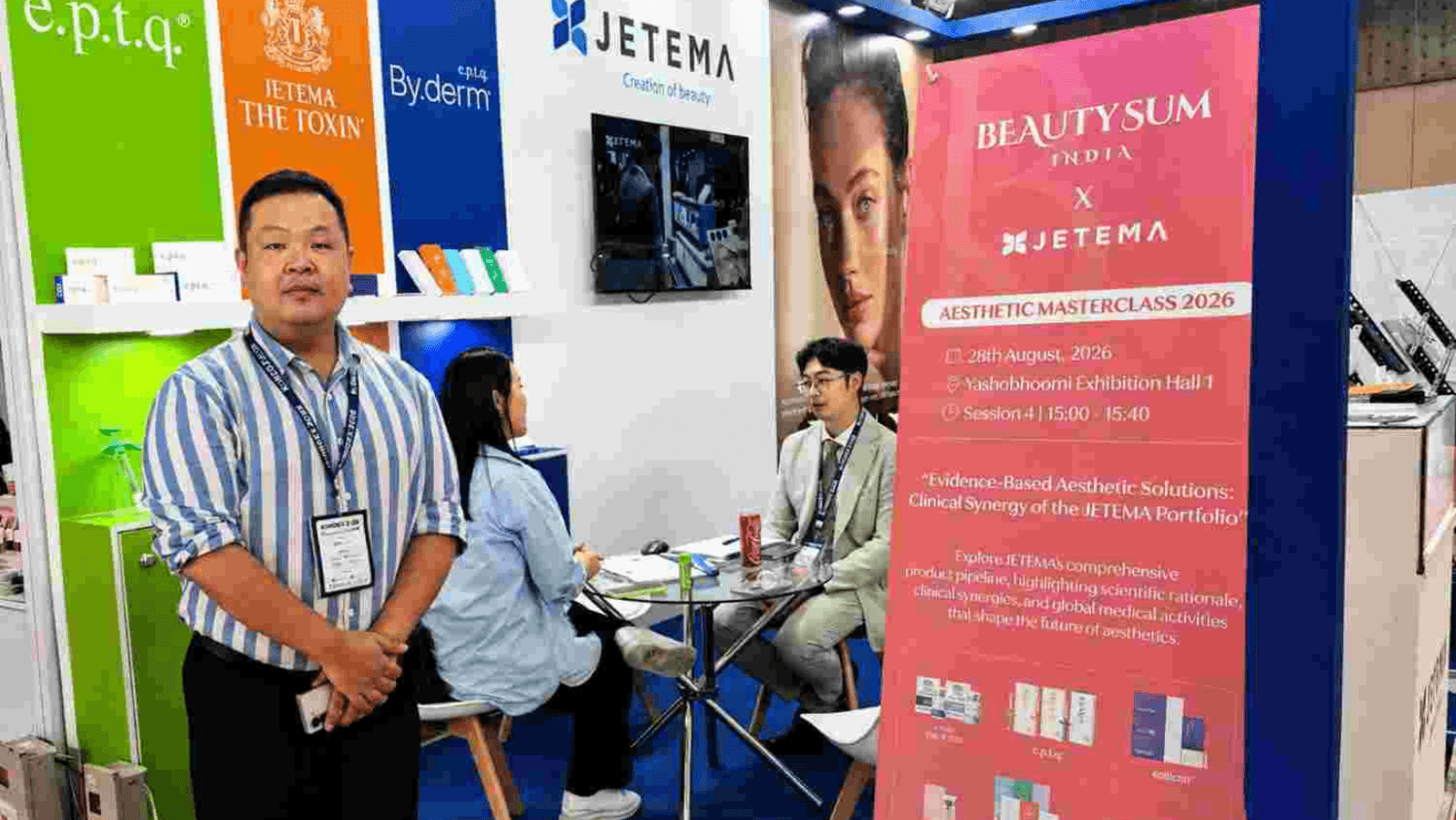
India could move directly towards preventive and natural-looking aesthetic treatments, according to Korean pharmaceutical and aesthetics company JETEMA. Pablo Kim, Executive Director, Global Business Department at JETEMA, said India presents significant potential for the company.
JETEMA operates across more than 70 countries and is currently studying the Indian market before establishing a formal presence. Kim said India differs significantly from other markets because of its size, diversity and professional ecosystem.
“India is quite different compared with the rest of the countries where we operate,” Kim said.
The company wants to understand India’s market structure before expanding its operations. “It is not necessarily difficult—it is diverse. We first need to understand the market, its professional ecosystem and even how terms such as ‘distributor’ are defined and applied here.”
India could skip traditional market development stages
JETEMA believes India could move faster than mature aesthetic markets. Kim said South Korea’s aesthetic industry changed significantly over the past two decades. Treatments once limited to wealthy consumers became more accessible as competition increased and techniques improved.
Procedure costs also declined as the market expanded. The focus of consumers has also changed over time. “Twenty years ago, people generally sought aesthetic procedures after ageing became visible,” he said.
“Today, younger consumers start taking care of their skin much earlier. The trend has moved from anti-ageing to slow ageing and now towards prevention.”
Kim believes India could complete this transition faster than South Korea did. He compared this potential shift with how emerging markets rapidly adopted newer mobile technologies. Countries can sometimes bypass earlier development stages and adopt newer practices directly.
Education remains critical
Kim said India needs stronger scientific education before the aesthetic market can expand sustainably. “We need to educate doctors, clinics, sales professionals and consumers,” he said.
He believes better training could increase competition and improve access to aesthetic treatments. “If doctors receive appropriate training and more clinics enter the sector, competition will increase, prices can come down and aesthetic treatments will become accessible to a much wider population.”
During his market study, Kim visited Indian clinics and interacted with local doctors. He found that some aesthetic procedures cost more in India than in South Korea. He also said Korean treatments can cost less than comparable procedures across several Asian markets.
South Korea combines competitive pricing with advanced expertise, supporting its position in international aesthetic tourism.
Natural-looking results gain importance
Kim identified natural-looking results as another major development in South Korea’s aesthetic market. Consumers increasingly want subtle improvements rather than visibly altered facial features.
“The latest trend is natural-looking improvement,” he said. “People should notice that you look better, but they should not be able to identify exactly what you have done.”
Kim said Korean practitioners have developed considerable expertise in achieving subtle aesthetic outcomes. Indian consumers already show strong awareness of Korean cosmetics and skincare products. However, awareness of Korea’s medical-aesthetic capabilities remains comparatively limited.
JETEMA sees this gap as an opportunity but believes market education must come before aggressive expansion.
JETEMA sees significant potential
JETEMA describes India’s large population as a major opportunity for the aesthetic industry. However, Kim stressed that companies must approach the market through scientific education and professional engagement. “The Indian aesthetic market has not yet been fully explored,” Kim said.
He said JETEMA must understand India’s market properly and develop relationships with medical professionals. The company also wants to educate consumers and other industry stakeholders.
Also read: Brilliance Cosmocare raises $200,000 in seed funding